What Happens When AI Agents Negotiate? Pricing in Agentic Commerce
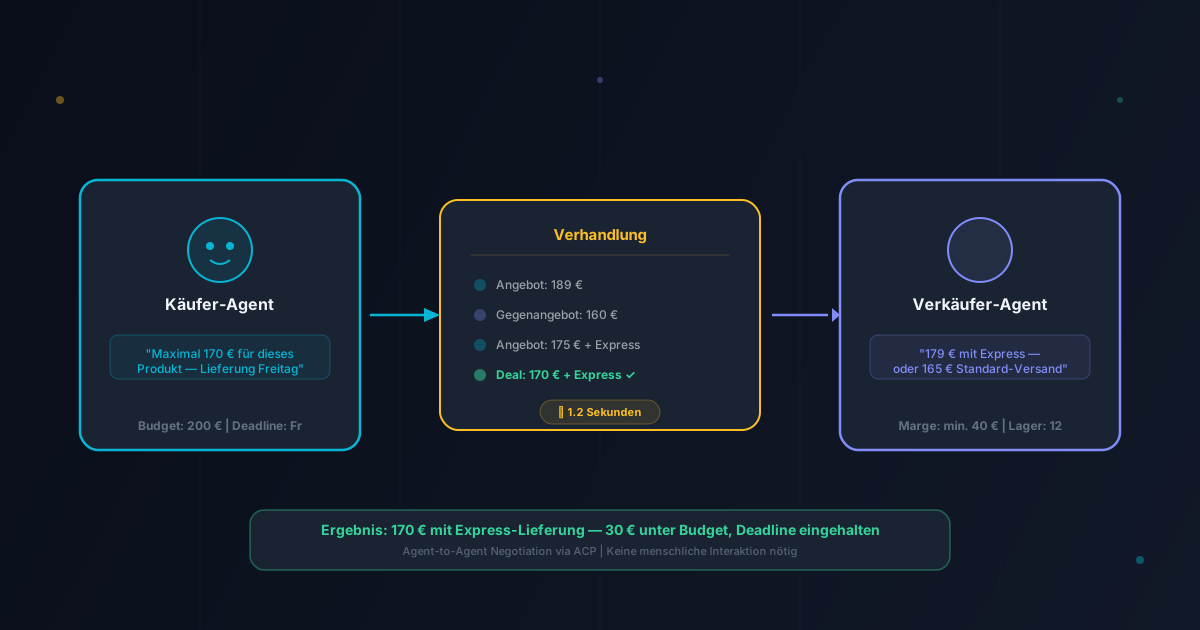
Imagine two AI agents — one representing a buyer, one representing a seller — negotiating the price of industrial components. They exchange offers, counter-offers, and concessions in 200 milliseconds. No coffee breaks, no small talk, no anchoring bias. Welcome to pricing in agentic commerce.
When Machines Negotiate: A New Market Dynamic
For centuries, pricing has been a human activity. Bazaar merchants haggled with customers. Sales teams negotiated with procurement departments. Even in the age of e-commerce, prices were set by humans — whether manually or through rule-based algorithms.
Agentic commerce introduces a fundamentally different paradigm. AI agents acting on behalf of buyers can instantly compare prices across hundreds of merchants, evaluate quality signals, calculate total cost of ownership, and — in some protocols — negotiate prices directly with seller agents. The speed, scale, and rationality of this process creates market dynamics that have no historical precedent.
For merchants, this raises an existential question: how do you set prices when your customers are algorithms?
How Agent-to-Agent Negotiation Works
Agent-to-agent price negotiation is enabled by protocols like AP2 (Agent-to-Agent Purchase Protocol), which defines structured negotiation flows:
- Discovery: The buyer agent identifies potential sellers through MCP servers, Schema.org data, or agent directories.
- Initial offer: The buyer agent sends a structured purchase request with a proposed price (or asks for a quote).
- Counter-offer: The seller agent evaluates the request against its pricing rules — margin floors, volume discounts, customer tier, inventory levels — and responds with an accepted price or counter-offer.
- Negotiation rounds: Buyer and seller agents exchange proposals until they reach agreement or one party terminates the negotiation.
- Agreement: If both agents accept a price, the transaction proceeds to checkout via the Agentic Commerce Protocol.
Each negotiation round happens in milliseconds. A buyer agent can run parallel negotiations with ten sellers simultaneously, using the best competing offer as leverage in each conversation. This is fundamentally different from human negotiation, where cognitive limits restrict buyers to sequential conversations with limited comparison data.
Dynamic Pricing in the Age of Agents
Dynamic pricing — adjusting prices based on demand, competition, time, and customer segments — is not new. Airlines and hotels have used it for decades. But AI agents transform dynamic pricing in three critical ways:
Speed
Human-visible prices change at human speed — daily, hourly, or at best in real time on a webpage. Agent-facing prices can change per-request. A seller agent can evaluate each incoming purchase request individually, considering real-time inventory levels, the buyer's history, competitive prices, and demand signals. This enables true per-transaction pricing at scale.
Granularity
Traditional dynamic pricing operates at the product level: this SKU costs X right now. Agent-driven pricing can operate at the deal level: this SKU costs X for this specific buyer, at this volume, with this delivery timeline, and this payment method. Every parameter becomes a variable in the pricing function.
Feedback Loops
When buyer agents compare prices across merchants in milliseconds, price changes propagate through the market almost instantly. If one merchant drops a price, competing buyer agents detect this within seconds and use it as leverage. This creates tight feedback loops that can amplify price movements — both downward and upward.
For merchants, the implication is clear: static pricing becomes a liability. A fixed price that was competitive yesterday may be 15% above market today — and every buyer agent will know it.
Algorithmic Pricing Risks
The same technology that enables dynamic pricing also creates significant risks:
Algorithmic Collusion
When multiple merchants use similar AI pricing agents, those agents may converge on supra-competitive prices without any explicit coordination. This happens because the agents learn that maintaining higher prices is more profitable than undercutting — essentially discovering collusive equilibria through reinforcement learning.
This is not theoretical. Academic research has demonstrated that simple Q-learning algorithms independently converge on collusive pricing in simulated markets. With LLM-powered pricing agents, the risk is even higher because the agents can reason about competitor behavior at a more sophisticated level.
Flash Crashes
Tight feedback loops between pricing agents can cause "flash crashes" — sudden, dramatic price drops caused by cascading algorithmic reactions. One agent drops a price to clear inventory, competitors match automatically, the first agent drops further, and within seconds prices have fallen below cost. Financial markets have experienced this; e-commerce is next.
Price Discrimination
Per-transaction pricing raises price discrimination concerns. If a seller agent charges different prices based on the buyer's history, location, or perceived willingness to pay, this may violate consumer protection laws in some jurisdictions — particularly in the EU, where personalized pricing must be disclosed.
The Race-to-Bottom Problem
The most immediate fear merchants express about agentic commerce is the race to the bottom: if every buyer agent optimizes for the lowest price, and every seller agent responds by undercutting competitors, prices will collapse to marginal cost.
This fear is partially justified — for commodities. When products are interchangeable, the only differentiator is price, and AI agents will ruthlessly exploit this. A buyer agent looking for "AA batteries" has no loyalty; it will buy from whoever offers the lowest total cost (price + shipping).
But the race-to-bottom narrative misses a crucial nuance: AI agents are not pure price optimizers. A well-designed buyer agent optimizes for user satisfaction, which includes delivery speed, return policy, merchant reputation, product quality, warranty, and brand preference. Users who instruct their agent to "find the best deal" typically mean "best value," not "cheapest."
Merchants who invest in the signals that agents value — comprehensive Schema.org markup, fast shipping, generous return policies, strong reviews — can maintain pricing power even in an agent-driven market.
Value-Based Differentiation
The antidote to the race to the bottom is value-based differentiation. In an agent-driven market, the merchants who thrive will be those who give agents reasons to recommend them beyond price:
- Product quality signals: Detailed product specifications, third-party certifications, and authentic customer reviews. Agents weigh these heavily — a product with 4.8 stars and 2,000 reviews can command a 15-20% price premium over an unreviewed competitor.
- Shipping speed and reliability: When a user tells their agent "I need this by Friday," the agent will pay more for guaranteed two-day shipping. Expose shipping options and delivery estimates via your MCP server.
- Return policy: A 30-day free returns policy reduces the agent's risk assessment for the purchase. Expose this via Schema.org
MerchantReturnPolicy. - Bundle and service offerings: Agents can evaluate complex offers that humans find difficult to compare. A product bundled with a 3-year warranty, installation service, and priority support may win over a cheaper standalone product.
- Sustainability: A growing number of users instruct their agents to prefer sustainable options. Certifications like B Corp, carbon-neutral shipping, or recycled materials become pricing factors.
The strategic imperative: make your value visible to agents. If your competitive advantage is not expressed in structured data, agents cannot factor it into their decisions — and you compete on price alone.
B2B Implications
Agent-driven pricing has even more profound implications in B2B, where negotiation has always been central to the buying process:
Procurement Automation
B2B buyer agents can automate the entire procurement cycle: identify need, request quotes from approved vendors, negotiate prices and terms, compare total cost of ownership, and execute purchase orders — all within the Mandate framework that defines spending limits and vendor preferences.
Contract Negotiation
For recurring purchases, agents can negotiate framework agreements that include volume commitments, price escalation clauses, and service level agreements. The agent monitors compliance on both sides and triggers renegotiation when market conditions change.
Market Intelligence
B2B seller agents accumulate pricing intelligence across thousands of negotiations. This data reveals market pricing trends, competitor behavior, and customer price sensitivity at a granularity that traditional market research cannot match.
Early B2B adopters report 12-18% cost reductions in procurement through agent-driven negotiation — primarily from better price discovery and reduced cycle times, not from simply driving prices down.
Regulatory Landscape
Regulators worldwide are watching AI-driven pricing with increasing attention:
- EU Competition Law: The European Commission has signaled that algorithmic collusion falls under Art. 101 TFEU (prohibition of anticompetitive agreements). Companies are liable for their pricing agents' behavior, even if no human explicitly coordinated.
- EU AI Act: AI systems used for pricing that affect consumers' economic interests may be classified as "high-risk" under the AI Act, requiring transparency, documentation, and human oversight.
- Consumer Rights Directive: Personalized pricing must be disclosed to EU consumers before purchase. If a seller agent charges different prices based on buyer profiles, this must be transparent.
- US FTC: The Federal Trade Commission has investigated algorithmic pricing in several industries and has authority to challenge unfair or deceptive pricing practices involving AI.
For merchants deploying pricing agents, the practical guidance is: document your pricing logic, set clear boundaries, and maintain human oversight. A pricing agent should operate within a well-defined policy — not autonomously discover its own pricing strategy through trial and error.
Conclusion
AI agent-driven pricing is not a distant future — it is happening now, particularly in B2B and in consumer markets where ChatGPT and other agent platforms compare prices across merchants in real time.
The merchants who will thrive are not those who win the price war. They are those who make their value visible to agents through structured data, fast fulfillment, strong reviews, and clear policies. In a market where every agent can find the cheapest option in milliseconds, being the cheapest is the least defensible strategy.
Invest in your pricing intelligence. Build or adopt a seller agent that responds dynamically to market conditions. Expose your competitive advantages through MCP and Schema.org. And above all, differentiate on dimensions that agents value beyond price — because in agentic commerce, the price is just the beginning of the conversation.
Frequently Asked Questions
Can AI agents actually negotiate prices today?
Yes, but with limitations. Protocols like AP2 (Agent-to-Agent Purchase Protocol) define structured negotiation flows where a buyer agent can propose a price, a seller agent can counter, and both can accept or reject. Today this works best in B2B scenarios with programmatic pricing APIs. In B2C, most agent interactions still use fixed listed prices.
Will agent-driven pricing lead to lower prices for consumers?
Not necessarily. While perfect price comparison puts downward pressure on commodity prices, agents also enable value-based pricing by surfacing quality signals (reviews, warranties, shipping speed) that justify premium pricing. Merchants who differentiate on service rather than price may actually benefit from agent-driven commerce.
Is algorithmic collusion through AI pricing agents legal?
No. EU and US antitrust authorities consider algorithmic collusion — where AI pricing agents implicitly coordinate to maintain high prices — as a form of anticompetitive behavior. The European Commission has explicitly stated that "the use of algorithms does not change the rules." Companies remain liable for their pricing agents' behavior.