Why AI Agents Are the New SEO
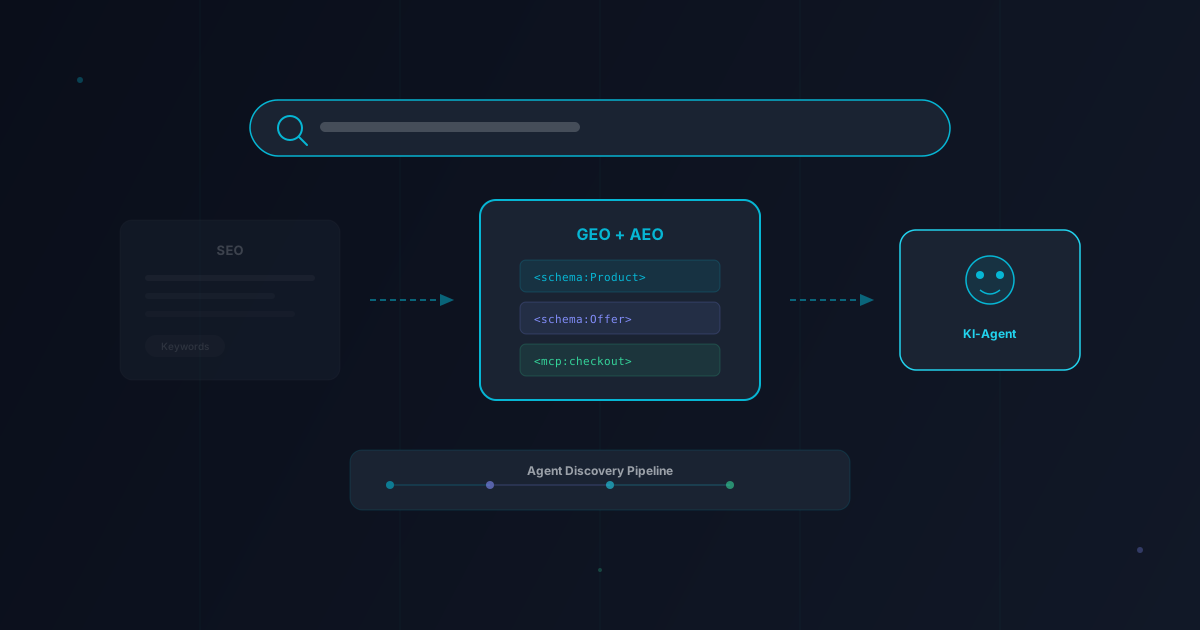
For two decades, SEO has been the lifeline of e-commerce. But when AI agents take over the purchase process, an uncomfortable question arises: Who are we optimizing for — humans or machines?
The End of 10 Blue Links
Google Search as we know it is changing fundamentally. Instead of ten blue links, Google increasingly shows AI Overviews — AI-generated summaries that answer the query directly. In many cases, the user doesn't click a search result at all.
For e-commerce, this means: Even if you rank #1, Google's AI might show the answer — including a product recommendation — directly in search. Your SEO no longer determines the click; whether the AI considers your product relevant does.
In parallel, a second channel is growing: AI agents that shop autonomously. These agents don't use search engines in the traditional sense. They query APIs, read structured data, and use tool discovery via MCP.
What Is GEO?
Generative Engine Optimization (GEO) is the discipline that supplements SEO for AI-generated answers. While SEO asks "How do I rank in search results?", GEO asks: "How do I get mentioned in the AI-generated answer?"
- Authority: AI models weight sources considered authoritative. Industry leaders, trade publications, and official documentation are cited more frequently.
- Structured statements: Clear, factual statements are preferred. "Product X has 12-hour battery life" is better than vague marketing speak.
- Source diversity: When your brand is mentioned across multiple trustworthy sources (reviews, trade media), the likelihood of AI recommendation increases.
What Is AEO?
Agent Engine Optimization (AEO) goes one step further. While GEO targets visibility in AI answers, AEO focuses on machine-readability for autonomous agents.
An AI agent shopping for a user doesn't need a beautiful product page. It needs:
- Structured product data: Schema.org Product markup with price, availability, specifications
- API access: A checkout API through which the agent can complete the transaction
- Tool discovery: An MCP server that tells the agent what actions are possible
- Trust signals: Ratings, certifications, and return policies in machine-readable form
GEO vs. SEO: The Differences
| Criterion | SEO | GEO | AEO |
|---|---|---|---|
| Audience | Human (searcher) | AI (answer engine) | Agent (buyer) |
| Medium | Search results | AI-generated answers | API access |
| Success Metric | Rankings, CTR, traffic | AI mentions, citations | Agent transactions |
| Core Action | Content, backlinks | Authority, structure | APIs, Schema, MCP |
| Timeline | Established | Growing (2025+) | Emerging (2026+) |
Practical Implementation
Step 1: Expand Schema.org Markup
Extend your existing Schema.org markup with detailed product information. Every product should at minimum have Product with name, description, SKU, brand; Offer with price, availability; AggregateRating with real review data.
Step 2: Optimize Product Data for Machines
Write product descriptions that work for both humans and AI: lead with concrete facts, use standardized specification formats, answer common questions directly on the product page, use clear comparison tables for multiple variants.
Step 3: Provide a Checkout API
The most important AEO measure: Expose your checkout as an API. Without an API, no agent can buy from you — regardless of how good your product data is. Details in the merchant guide.
MCP Servers as a New SEO Channel
An MCP server is to AI agents what a sitemap is to search engines: a machine-readable description of your capabilities. It tells the agent what products you offer, how to search, how to complete a purchase, and what information is available.
Shopify merchants have it easy: the Shopify MCP server is already natively integrated. For custom shops, open-source frameworks like FastMCP simplify implementation.
Conclusion
Optimization for AI agents isn't the future — it's the present. Every day your shop isn't machine-readable is a day AI agents recommend your competition.
The good news: GEO and AEO build on SEO. They don't replace what you're already doing — they extend it. Start with structured data, invest in a checkout API, and build an MCP server. The order depends on your resources. But start.
Frequently Asked Questions
Is SEO dead now?
No. Traditional SEO remains relevant as long as people use search engines. But the share of queries answered by AI is growing continuously. GEO and AEO are additions that are becoming increasingly important.
How do I measure my GEO success?
New metrics are needed: How often is your product mentioned in AI-generated answers? How often is your brand cited as a source? GEO-specific analytics tools are emerging. Until then: monitor AI responses for relevant queries.
What does implementing an MCP server cost?
For Shopify merchants, it's free — the Shopify MCP server is natively integrated. For custom shops, the effort depends on complexity. A simple MCP server with product search and checkout reference can be implemented in a few days.