Schema.org in the Age of AI Agents
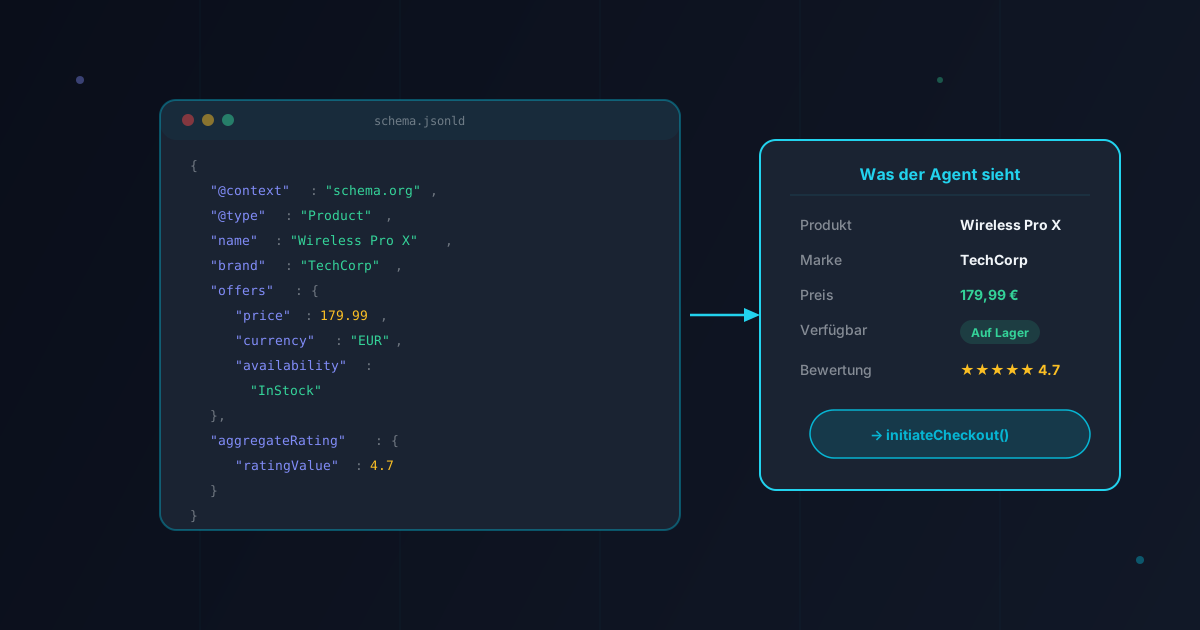
For over a decade, Schema.org markup helped search engines understand web pages. Now it serves a new audience: AI agents that shop autonomously. Structured data is no longer just an SEO advantage — it is the language AI agents use to evaluate your products.
Why Schema.org Matters More Than Ever
When a human visits your product page, they see images, read descriptions, check the price, and scroll through reviews. They use visual cues, layout conventions, and intuition to understand the page. An AI agent has none of these advantages.
AI agents rely on structured data to understand what a page contains. While modern LLMs can extract information from unstructured HTML, the process is slow, error-prone, and expensive in tokens. Schema.org markup gives agents direct access to the facts — product name, price, availability, ratings — without guessing.
This shift has profound implications. In the SEO and GEO world, we have long treated Schema.org as a nice-to-have for rich snippets. In agentic commerce, it becomes a hard requirement. An AI agent comparing headphones across ten shops will prioritize the shops that provide clean, complete structured data — because it can process those listings faster and with higher confidence.
The Essential Schema.org Types for E-Commerce
Not all Schema.org types carry equal weight for AI agents. Here are the ones that matter most, ranked by impact:
Product
The foundation of everything. The Product type describes what you sell. Essential properties include name, description, image, sku, brand, category, and gtin (the global trade item number). AI agents use the GTIN to cross-reference your product across databases, verify authenticity, and compare prices with other merchants.
Offer
Nested within Product, the Offer type carries commercial information: price, priceCurrency, availability, priceValidUntil, and seller. This is what agents use to make purchasing decisions. A missing availability property means the agent cannot confirm stock — and will likely skip your product.
AggregateRating
AI agents weigh social proof heavily. The AggregateRating type provides ratingValue, reviewCount, and bestRating. Agents use this to rank products when multiple merchants offer the same item. A product with 4.7 stars from 1,200 reviews will consistently outrank one with 4.8 stars from 12 reviews — agents understand statistical significance.
Review
Individual Review entries give agents qualitative data. Modern agents do not just count stars — they read review text to identify specific product strengths and weaknesses. If a user asks for "headphones good for running," the agent will search reviews for mentions of exercise, sweat resistance, and fit stability.
BreadcrumbList
The BreadcrumbList type helps agents understand your site's taxonomy. It reveals product categories and hierarchies — information agents use to navigate your catalog and understand product relationships.
How AI Agents Parse Structured Data
Understanding how agents consume Schema.org data helps you optimize your markup. The process typically follows four stages:
- Discovery: The agent crawls your page (or receives it from a search index) and extracts all JSON-LD blocks from the
<script type="application/ld+json">tags. - Parsing: The agent validates the JSON-LD against Schema.org type definitions. Properties that do not match expected types are discarded.
- Normalization: Prices are converted to the user's currency, availability statuses are mapped to a standard enum (InStock, OutOfStock, PreOrder), and ratings are normalized to a 0-1 scale.
- Ranking: The agent scores the product based on user intent, price, availability, ratings, shipping speed, and return policy. Products with incomplete data receive lower confidence scores.
The critical takeaway: incomplete markup is penalized. An agent comparing products will always prefer a listing with price, availability, ratings, and shipping information over one that only has price and name. Every missing property reduces your ranking in agent-driven shopping.
Practical JSON-LD Examples
Here is a production-ready JSON-LD example for a product page. This covers the minimum viable markup for agentic commerce:
A complete product markup includes the Product type with nested Offer, AggregateRating, and Review objects. Key properties to include in every product listing:
- Product level: name, description, image (array of URLs), sku, gtin13, brand (as Organization), category
- Offer level: price, priceCurrency, availability (use Schema.org ItemAvailability values like
https://schema.org/InStock), priceValidUntil, url, seller, shippingDetails - AggregateRating level: ratingValue, reviewCount, bestRating, worstRating
- Review level: author, datePublished, reviewRating, reviewBody
Two critical details that many merchants miss:
- Use absolute URLs for images. Relative URLs break when agents process your markup outside the context of your domain.
- Include
shippingDetailsin your Offer. Agents increasingly factor shipping cost and speed into their recommendations. TheOfferShippingDetailstype lets you specify shipping rate, delivery time, and shipping destination — information that helps agents serve users asking for "fastest delivery" or "free shipping."
Common Mistakes to Avoid
| Mistake | Impact | Fix |
|---|---|---|
| Price as string ("$49.99") | Agent cannot compare numerically | Use numeric value: 49.99 |
| Missing availability | Agent assumes out of stock | Always include ItemAvailability |
| Stale priceValidUntil | Agent treats offer as expired | Update or remove if not applicable |
| Fabricated reviews | Trust score drops when cross-referenced | Only use authentic customer reviews |
| Missing GTIN/SKU | Agent cannot cross-reference product | Include at least one product identifier |
Beyond Product Markup: Advanced Schemas
Product and Offer are the foundation, but several additional Schema.org types provide significant advantages in agentic commerce:
FAQPage
AI agents frequently need to answer product-related questions: "Is this dishwasher safe?" "Does it work with 220V?" The FAQPage type lets you provide these answers in structured form. Agents extract FAQ data to answer user questions without needing to parse your entire page.
ReturnPolicy
The MerchantReturnPolicy type communicates your return window, return method, and conditions. For agents optimizing for buyer confidence, a clear 30-day return policy can be the deciding factor between your shop and a competitor.
Organization
The Organization type establishes your brand identity. Include your name, logo, contact information, and social profiles. Agents use this to verify merchant legitimacy — especially important in an era where trust is a key differentiator.
LocalBusiness
If you have physical locations, LocalBusiness markup enables "buy online, pick up in store" scenarios. Agents can match users asking for same-day availability with merchants who have local inventory.
From Schema.org to MCP: The Next Step
Schema.org and MCP are complementary technologies, not competitors. Schema.org is a passive data layer — agents crawl your pages and extract what they find. MCP is an active interaction layer — agents connect to your server and call tools in real time.
The typical agent workflow combines both:
- Discovery via Schema.org: The agent finds your product through structured data on your website (or via a search index that uses your structured data).
- Verification via MCP: The agent connects to your MCP server to confirm real-time price and availability.
- Transaction via ACP: The agent initiates checkout through the Agentic Commerce Protocol.
This means Schema.org is your top-of-funnel tool for agent discovery, while MCP and Checkout APIs handle the mid- and bottom-of-funnel interactions. Neglecting either layer means losing agent-driven traffic at some point in the journey.
For merchants who are not yet ready to build an MCP server, Schema.org is the minimum viable step. It requires no backend changes — just adding JSON-LD to your existing pages. And it immediately makes your products visible to every AI agent that crawls the web.
Conclusion
Schema.org markup has evolved from an SEO optimization into a critical infrastructure layer for agentic commerce. It is the language AI agents speak when they evaluate your products, compare your prices, and decide whether to recommend your shop.
The investment is minimal: a few hours to audit and improve your existing markup, using the essential types outlined above. The return is substantial: visibility to a growing population of AI agents that collectively influence billions of dollars in purchasing decisions.
Start with Product, Offer, AggregateRating, and Review. Ensure every property is accurate, complete, and current. Then extend to FAQPage, ReturnPolicy, and ShippingDetails. Each additional schema type is another signal that helps agents trust and recommend your shop.
In the age of AI agents, structured data is not metadata — it is your storefront.
Frequently Asked Questions
Is Schema.org still relevant when AI agents use MCP?
Yes — Schema.org and MCP serve complementary purposes. Schema.org is a passive discovery layer: agents crawl your pages and extract structured data without requiring API access. MCP is an active interaction layer: agents connect to your server and call tools. Most agents use Schema.org for initial product discovery and MCP for checkout. You need both.
Which Schema.org types are most important for agentic commerce?
Product, Offer, AggregateRating, and Review are the essential four. Product describes what you sell, Offer includes price and availability, AggregateRating provides social proof, and Review gives agents detailed customer feedback. Together, they give AI agents everything they need to evaluate and recommend your products.
Can incorrect Schema.org markup hurt my visibility to AI agents?
Yes. AI agents treat structured data as ground truth. If your Schema.org markup shows incorrect prices, false availability, or fabricated reviews, agents will relay this misinformation to users — and your shop may be flagged as unreliable. Accuracy is more important than completeness.