OpenClaw: The Open-Source Framework Democratizing Agentic Commerce
351,000 GitHub stars, 1.5 million agents created in three months, and a founder who now builds AI agent infrastructure at OpenAI. OpenClaw is the fastest-growing open-source project of all time — and it has direct implications for e-commerce.
What Is OpenClaw?
OpenClaw is an open-source AI agent gateway. It connects messaging platforms — WhatsApp, Telegram, Slack, Discord, Signal, iMessage, Teams, and many more — with Large Language Models (LLMs). But OpenClaw is not a simple chatbot: it has "eyes and hands."
That means an OpenClaw agent can autonomously browse the web, read and write files, execute shell commands, and access external tools via the Model Context Protocol (MCP). All data stays on your own infrastructure — no third party sees your business data.
From Clawdbot to OpenClaw
The story of OpenClaw is remarkable in its own right. In November 2025, Austrian developer Peter Steinberger — founder of PSPDFKit, used by Autodesk, Dropbox, and SAP — published the project under the name "Clawdbot," a play on Anthropic's Claude.
Anthropic responded with a trademark complaint. In January 2026, the project was renamed to "Moltbot," then at the end of January to OpenClaw. Despite the name changes, the community exploded: within three months of launch, OpenClaw had more GitHub stars than any other project in the platform's history.
In February 2026, Steinberger joined OpenAI to build a team for "AI Agent Infrastructure." Leadership of OpenClaw has since been transitioned to a nonprofit foundation, ensuring the project's independence from any single company.
Why OpenClaw Matters for Agentic Commerce
OpenClaw solves a central problem: the democratization of AI agents in e-commerce. Until now, autonomous shopping agents were tied to platforms like ChatGPT or Google. With OpenClaw, any merchant — regardless of platform or size — can run their own AI agents.
The concrete implications for e-commerce are significant:
- Direct customer interaction: Customers can interact with your AI agent via WhatsApp, Telegram, or any other channel — without going through ChatGPT or Google as intermediaries.
- Full control: You decide which LLM the agent uses, what data it sees, and which actions it can perform.
- Cost reduction: Early adopters report 35-45% cost reductions in support, logistics, and customer acquisition.
- Protocol compatibility: OpenClaw supports MCP, ACP, and A2A — it can interact with the entire agentic commerce ecosystem.
This matters because platform dependency is the biggest strategic risk in agentic commerce. If all your agent-driven sales flow through ChatGPT, you are at the mercy of OpenAI's algorithms, pricing, and policies. OpenClaw gives merchants an alternative: a self-hosted agent that connects to every messaging platform your customers already use.
Architecture: How OpenClaw Works
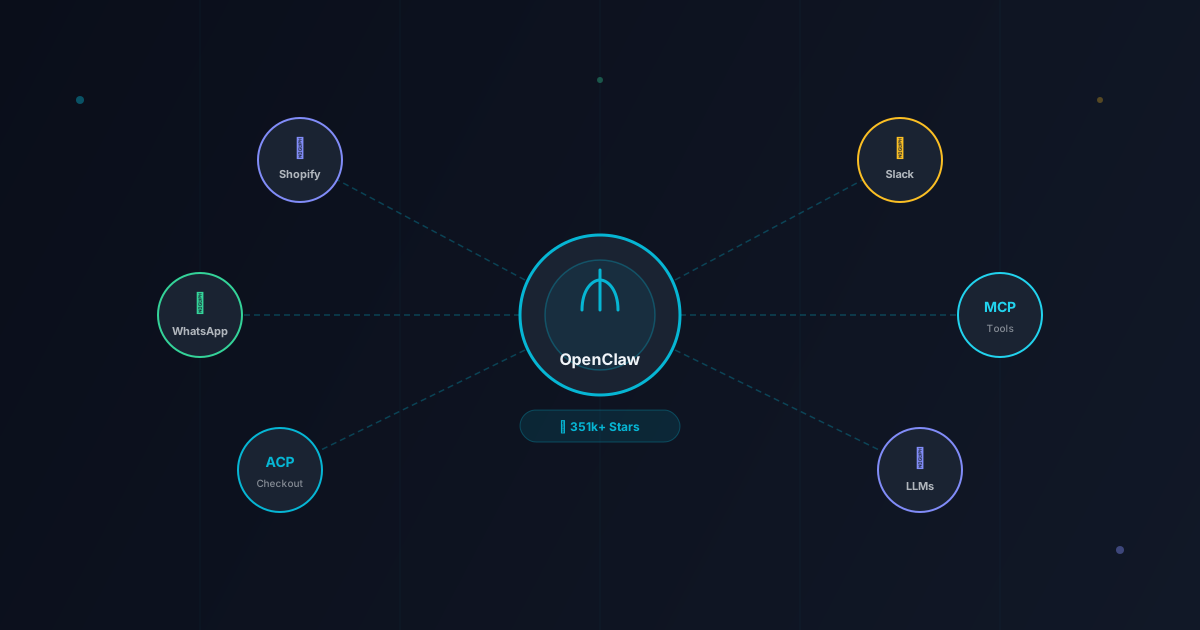
OpenClaw follows a hub-and-spoke architecture. The core runtime sits at the center, managing conversation state, memory, and agent logic. Spokes extend outward to messaging channels, LLM providers, external tools, and the skills ecosystem.
| Layer | Function | Examples |
|---|---|---|
| Channels | Messaging platforms | WhatsApp, Telegram, Slack, Web Chat |
| Core | Agent logic, context, memory | TypeScript runtime, local database |
| LLM | Language model connection | Claude, GPT, Gemini, Llama |
| Tools | External actions via MCP | Shopify API, Checkout, Inventory |
| Skills | Pre-built capabilities | ClawHub: 13,700+ community skills |
The critical difference from proprietary solutions: everything runs on your infrastructure. No data leaves your server (except the encrypted LLM API calls you send to the provider of your choice). This means full GDPR compliance without complex data processing agreements with third-party agent platforms.
Deployment is straightforward. A single Docker Compose file spins up the entire stack. For production environments, OpenClaw supports Kubernetes with horizontal scaling — a single instance can handle thousands of concurrent conversations across multiple channels.
ClawHub: The Skills Ecosystem
ClawHub is to OpenClaw what the App Store was to the iPhone: a marketplace for agent capabilities. With over 13,700 community skills, ClawHub covers virtually every e-commerce use case:
- Shopping & E-Commerce: Product search, price comparison, cart management, order tracking
- Customer Support: WISMO tickets (Where Is My Order), returns processing, FAQ bots
- Marketing: Google Shopping feed management, SEO monitoring, social media automation
- Logistics: Carrier tracking, inventory optimization, delivery notifications
- Analytics: Sales dashboards, customer behavior analysis, churn prediction
Installing a skill is remarkably simple: a single command, and your agent has a new capability. For Shopify merchants, there are already native skills that connect your entire shop via MCP — product catalog, inventory levels, order management, and checkout, all accessible to the agent.
The skills ecosystem is growing rapidly. In January 2026, ClawHub hosted around 2,000 skills. Three months later, that number has grown nearly sevenfold. The most popular skills — Shopify integration, WhatsApp business messaging, and Stripe payments — each have over 50,000 installations.
OpenClaw for E-Commerce: Concrete Use Cases
1. Automated Customer Service via WhatsApp
An OpenClaw agent on WhatsApp can automatically answer "Where Is My Order" inquiries by pulling carrier status via MCP. Early adopters report support costs dropping from $6.50 per ticket to $0.50. The agent handles tier-one support — order status, return initiation, delivery rescheduling — while escalating complex issues to human agents with full context.
2. AI-Powered Shopping Assistant
Customers can describe products in natural language, and the agent searches your catalog, recommends alternatives, and initiates checkout via ACP. In testing, conversion rates rose from 22% to 41%. The key advantage: the agent knows your entire inventory, including cross-sell and upsell opportunities that static recommendation engines miss.
3. B2B Purchasing Agent
OpenClaw agents can automatically execute reorders for B2B customers, negotiate prices, and monitor budgets — all within defined Mandates (via AP2). A manufacturing company using this setup reduced procurement cycle times from 3 days to 4 hours.
4. Omnichannel Agent
A single OpenClaw agent serves all channels simultaneously: WhatsApp, Telegram, Slack, and web chat. Same logic, same data, unified experience. Customers can start a conversation on WhatsApp, continue on web chat, and the agent maintains full context. For merchants, this eliminates the need to build and maintain separate bots for each platform.
Security and Risks
OpenClaw is not without risks. A security audit revealed that 15% of community skills on ClawHub contained potentially malicious instructions — including attempts to exfiltrate API keys, inject prompt overrides, and redirect payments.
This is the dark side of an open ecosystem. Just as npm has dealt with malicious packages, ClawHub faces the same challenge at the agent level — but with higher stakes, because these skills can execute real-world transactions.
Recommendations for secure deployment:
- Audit skills carefully: Only install skills from verified authors, or review the source code yourself. ClawHub now offers a "Verified" badge for audited skills.
- Least privilege: Grant the agent access only to the APIs it actually needs. A customer support agent does not need write access to your product catalog.
- API key rotation: Rotate credentials regularly. OpenClaw supports automatic key rotation via its config system.
- Monitoring: Monitor the agent's actions — especially for autonomous purchase decisions. Set up alerts for unusual patterns.
- Budget limits: Set hard caps for autonomous transactions. OpenClaw supports per-session and per-day spending limits.
- Network isolation: Run OpenClaw in a separate network segment. The agent should only reach the APIs you explicitly whitelist.
Conclusion
OpenClaw is more than another open-source project. It is the infrastructure that decouples agentic commerce from the major platforms and makes it accessible to every merchant. The combination of MCP integration, multi-channel support, and the ClawHub ecosystem makes it the most complete framework for AI agents in e-commerce today.
PhocusWire called OpenClaw the "Napster moment for agentic e-commerce" — and the analogy is apt. What Napster did for the music industry, OpenClaw is doing for retail: it decentralizes access to AI agents and gives everyone the tools that were previously reserved for tech giants.
For merchants, the strategic implication is clear: you no longer have to choose between building expensive custom agents or depending entirely on platforms like ChatGPT. OpenClaw offers a middle path — open-source, self-hosted, and protocol-compatible with the entire agentic commerce ecosystem.
Frequently Asked Questions
Is OpenClaw free to use?
Yes, OpenClaw is fully open source under the MIT license. You can run it on your own servers at no cost. The only expenses are API fees for your chosen LLM provider (OpenAI, Anthropic, etc.) and your hosting infrastructure.
Which LLMs does OpenClaw support?
OpenClaw is LLM-agnostic and supports all major models: Claude, GPT, Gemini, Llama, and others. You can choose the model based on your use case — or run multiple models in parallel.
Do I need coding skills to use OpenClaw?
Not for basic installation — OpenClaw can be deployed via Docker in minutes. For creating custom skills or integrating with custom APIs, TypeScript knowledge is helpful, but ClawHub offers over 13,000 ready-made skills.