Checkout Without a Cart: How AI Agents Redefine the Purchase Flow
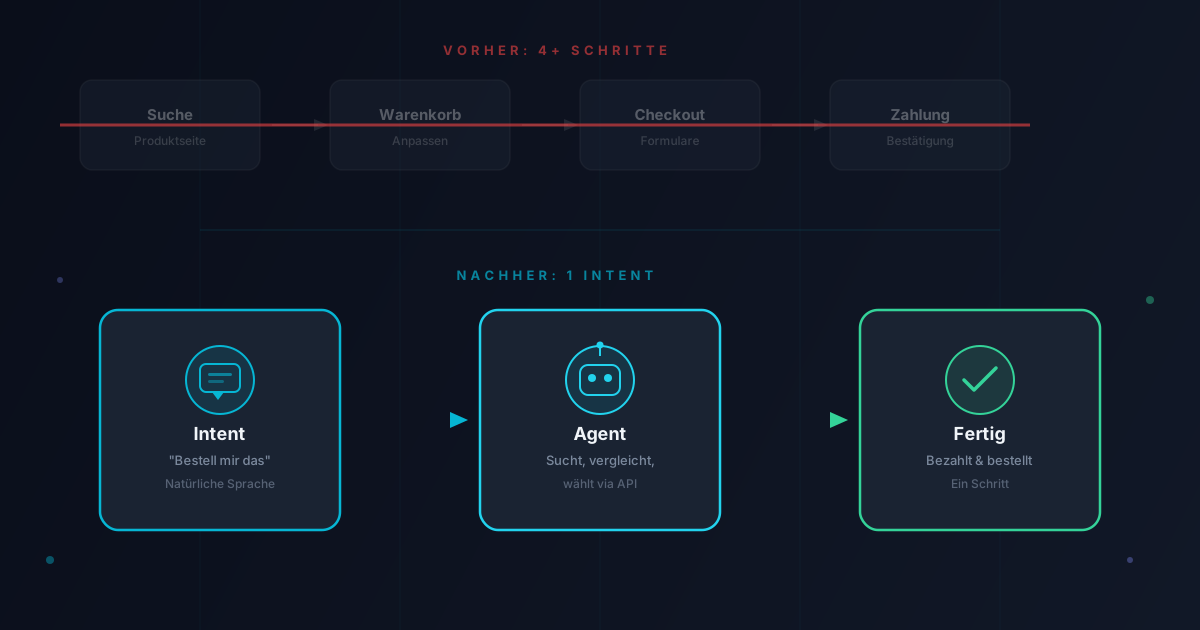
Search, compare, add to cart, enter address, choose payment method, confirm. Six steps every online buyer knows. AI agents replace them with a single sentence: "Order that for me."
The Funnel Is Dead
The e-commerce funnel — Awareness → Interest → Desire → Action — has been the foundational model of online retail for 25 years. Every step was optimized, A/B tested, and analyzed. Conversion rate optimization became its own discipline.
But the model is based on an assumption that no longer holds: The human navigates the purchase process themselves.
When an AI agent handles shopping, there's no funnel. No product page that needs to convince. No cart that gets abandoned. No checkout form that frustrates. There's only the intent — and the execution.
How Do AI Agents Shop?
An AI agent follows a fundamentally different process than a human:
- Intent parsing: The agent understands what the user wants — product, budget, preferences, delivery time.
- API query: The agent searches product catalogs via APIs and MCP servers — not websites.
- Automatic comparison: Price, rating, availability, and delivery time are compared in milliseconds.
- Checkout via API: The order is completed through a Checkout API — SharedPaymentToken, one API call, done.
The entire process takes seconds. And it happens nowhere on your website.
Intent-Based Commerce
The core of the shift is from navigation-based to intent-based commerce:
| Aspect | Navigation-Based (Today) | Intent-Based (Agent) |
|---|---|---|
| Starting Point | Search engine / URL | Natural language |
| Product Selection | Human browses and compares | Agent filters and recommends |
| Checkout | Forms, shopping cart | API call with token |
| Decision | Human weighs options | Agent optimizes by criteria |
| Duration | Minutes to days | Seconds |
| Drop-off Rate | ~70% | ~40% (intent to purchase) |
For the user, this is a massive simplification. For the merchant, it's a fundamental shift: Your website no longer sells — your API does.
What Happens to the Conversion Rate?
The classic conversion rate (visitors → buyers) loses its meaning in agent commerce. New metrics emerge instead:
- Agent Reach: How many AI agents can reach your shop via APIs?
- Intent-to-Purchase Rate: How many agent queries result in a purchase?
- Recommendation Rate: How often do agents recommend your product over alternatives?
- API Response Quality: How complete and structured are your product data?
Early data shows: Shops with optimized APIs and structured product data are recommended by agents 3-5x more often than shops that only have a website.
The New UX: Trust Over Clicks
When the purchase process is reduced to a single intent, the UX challenge shifts: It's no longer about guiding users through the funnel. It's about building trust — before the intent.
Trust in agent commerce is built through different factors than in traditional e-commerce:
- Data quality: Accurate prices, real-time availability, detailed specifications
- API reliability: Fast response times, no errors, consistent formats
- Transaction history: Agents learn which shops deliver reliably
- Reviews: Structured reviews and ratings as trust signals
What Merchants Need to Rebuild
1. Build a Checkout API
Your checkout must work as an API — not just a web form. ACP and UCP provide the standards.
2. Structure Product Data
Every product needs machine-readable data: Schema.org markup, standardized categories, comparable specifications. "Premium quality" is not a data point. "Battery life: 12h" is.
3. Implement an MCP Server
An MCP server makes your shop discoverable to agents. Without an MCP server, agents don't know your shop exists.
4. Define New KPIs
Supplement your existing e-commerce KPIs with agent-specific metrics. Measure API access, agent transactions, and recommendation rates alongside your website metrics.
Conclusion
The shopping cart won't disappear overnight. But its share of total revenue will decline — in favor of intent-based, API-driven transactions by AI agents.
Merchants who shift their infrastructure to API-first now won't just survive in a world without carts — they'll thrive. Because less friction means more conversion. And a purchase process that takes seconds instead of minutes is better for everyone.
Frequently Asked Questions
Do online shops no longer need a shopping cart?
The cart remains relevant for human customers. But for AI agents, it's unnecessary. The future lies in parallel experiences: cart for humans, API for agents.
How does upselling work without a cart?
AI agents can receive upselling options via the API and suggest them to the user. Instead of "customers also bought" on the product page, the agent says: "A protective case for $19 goes great with this — should I add it?"
Will I lose control over the shopping experience?
Partially, yes. The shopping experience is shaped by the agent, not your shop design. But you retain control over product data, prices, and checkout logic. The challenge: convey brand identity through structured data, not visual design.