Agentic Commerce 2026: 5 Trends Changing Online Retail
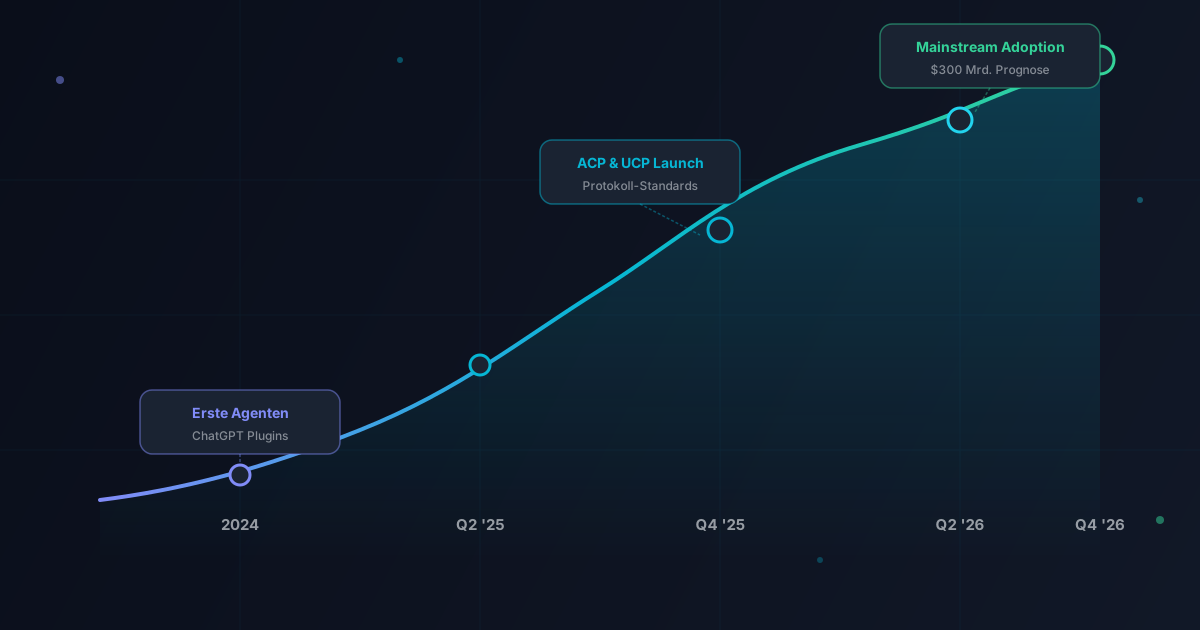
2025 was the year of protocols — ACP, UCP, and AP2 were defined. 2026 is the year of adoption. Five trends show where things are heading.
1. Checkout Moves into the Chat
The most obvious trend is also the most disruptive: buying without a shop. ChatGPT, Google Gemini, and other AI assistants are becoming full-fledged sales channels — with integrated checkout.
This is no longer a future vision. OpenAI's Instant Checkout is in production. Google's Business Agents are testing the shopping flow in search. And Shopify has announced that by the end of 2026, every Shopify store will be automatically accessible via AI agents.
2. Multi-Agent Systems Take Over Shopping
The next evolutionary step goes beyond a single agent. Multi-agent systems consist of specialized agents working together:
- Research Agent: Searches product catalogs and compares options
- Negotiation Agent: Negotiates prices and terms (especially in B2B)
- Payment Agent: Executes transactions and monitors budgets
- Logistics Agent: Tracks deliveries and initiates returns
The Model Context Protocol (MCP) from Anthropic is the foundation for this interoperability — it defines how agents use external tools and data sources.
3. SEO Becomes GEO and AEO
Search engine optimization has been the central discipline in e-commerce marketing for two decades. In 2026, it's being supplemented — and partially replaced — by two new disciplines:
- GEO (Generative Engine Optimization): Optimization for AI-generated answers. How is your product mentioned in a ChatGPT or Gemini response?
- AEO (Agent Engine Optimization): Optimization for autonomous AI agents. Can an agent find, understand, and purchase your product?
The key lies in structured, machine-readable data: Schema.org markup, MCP servers, Checkout APIs. More on our page about SEO and GEO.
4. Autonomous Payments Become Standard
The biggest barrier in Agentic Commerce has been payment: How can an agent pay without the human confirming every transaction?
| Model | Protocol | How It Works |
|---|---|---|
| SharedPaymentTokens | ACP | One-time token per transaction, human confirmation |
| Mandates | AP2 | Rule-based authorization, agent acts autonomously |
| Agent Pay | Mastercard | Card network-based agent authorization |
The convergence of these models becomes visible in 2026: Visa and Mastercard are integrating AP2-compatible Mandates. Stripe is extending ACP with autonomous payment options. The result is a spectrum from manual to fully autonomous.
5. The Platform Economy Shifts
Amazon, the previously dominant e-commerce platform, has not published its own agent protocol. This is noteworthy — and strategically risky.
Instead, new actors are positioning themselves as agent commerce platforms:
- ChatGPT becomes a shopping destination (ACP + 700M users)
- Google Search integrates Business Agents directly into search
- Shopify evolves into agent commerce infrastructure
- Klarna positions itself as an agent shopping platform
What This Means for Merchants
- API-First: Expose your checkout as an API — without an API, you're invisible to agents.
- Structured Data: Invest in machine-readable product data (Schema.org, MCP servers).
- Multi-Channel: Support multiple protocols — start with ACP, add UCP.
2026 decides who leads in Agentic Commerce. The technology is here. The protocols are defined. Now it's about execution.
Frequently Asked Questions
Will Agentic Commerce replace the traditional online shop?
Not entirely, but the share of purchases processed through AI agents will increase significantly. Gartner predicts that by 2028, one-third of all digital commerce transactions will run through autonomous agents.
Which industries benefit the most?
Standardized products with high comparability benefit fastest: electronics, fashion, groceries, household goods. Complex B2B products and luxury goods follow with a time delay.
Is the European market relevant for Agentic Commerce?
Absolutely. Europe is home to some of the world's largest e-commerce markets. ChatGPT has tens of millions of active users in the region. The ACP and UCP protocols are language-independent and already work across Europe.